2.7 GHz Dual-CPU G5 built May 2005 - Delphi LCS
By Bill S.
Posted: July 22, 2010
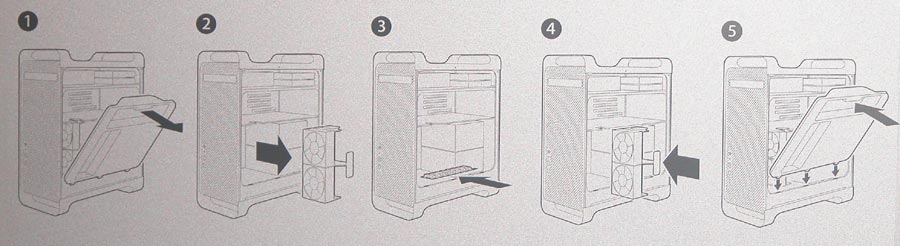
Power Mac G5 Take Apart Procedure Remove the two screws that mount the PCI card guide to the logic board. Apple power mac g5 User Manual, Page: 6 Power Mac G5 Repair. The PowerMac G5 is a desktop computer first produced in 2003 by the Apple Corporation. This guide will review the repair process of an Apple PowerMac G5 model number A1047 EMC. 3 Start up your Power Mac G5 and immediately hold down the T key. Your Power Mac G5 display shows the FireWire disk mode indicator, and the Power Mac G5 internal hard disk icon appears on the other computer’s desktop. 4 Drag the Power Mac G5 hard disk icon to the Trash on the other computer when you have finished transferring files.
(This is Page 2 of the 6 page article)
Disassembly (Follow ESD precautions before touching circuit boards, etc. - Discharge yourself by touching the case w/AC power cord connected, then disconnect power cord. A wrist (ground) strap can also be used. ESD precautions are also included in Apple's (limited) Power Mac G5 DIY Instructions. Apple's G5 related HT2580 article link now goes to their general Manuals page.)
11) The CPU/LCS assembly is secured to the computer interior (see Figure 6 above) by means of eight screws with tapered cones just under their heads. They are installed in split cylindrical standoffs. When tight, the screws' tapered heads spread the tops of the standoffs, trapping the assembly. Following up the ifixit article, when the LCS is removed, the assembly looks from the CPU board side as shown in Figure 7. The 'L'-shaped copper tubes are heat pipes, each connecting a Memory Controller chip (I think) to the aluminum heat sink secured to the bottom plate of the LCS. (These chips are not liquid cooled.) At this point you should have very good visual access to the LCS radiator, hoses, and radiator coolant pump. The 'white rice' area between the other side of the CPU board and the heat transfer modules of the LCS is still not easy to see. The following steps assume you want to continue and separate the CPUs from the LCS assembly.
Figure 7. LCS with CPU Boards Removed
12) Removing the CPU boards first requires removing the bottom plate to release the Memory Controller heat sinks. The bottom plate is connected to the bottom of the frame with two Allen screws as shown in Figure 8. Figure 9 shows the bottom plate's clips holding the bottoms of the heat sinks. Removing the screws allows the bottom plate to be slid carefully off the Memory Controller heat sinks. In Figure 10 which shows the bottom plate removed, you can just see portions of the bottoms of the Memory Controller heat sinks at the top of the picture. These heat sinks are fragile sheet aluminum - handle with care! Leave the Memory Controller heat sinks and pipes attached to the CPU boards.
Figure 8. LCS Bottom Plate

Figure 9. Bottom Plate Clips Holding Memory Controller Heat Sinks

Figure 10. Bottom Plate Removed (from a later disassembly step)
13) Once the bottom plate is off, there are 10 fasteners holding a CPU board to the LCS chassis. There are six Philips screws around the periphery of each board, and four Allen screws securing it to the heat transfer module. This is shown in Figure 11.
Figure 11. CPU Boards A and B with all fasteners present
14) I removed the four Allen screws on CPU A first, which released the board from the heat transfer module, then removed the six Philips screws, then lifted CPU A up and away from the LCS chassis. Same routine for CPU B. Be careful of the Memory Controller heat sinks when moving the CPU boards and setting them in a safe place.
Once the CPUs are off the LCS, you can clearly see the undersides of those boards. Figure 12 shows both CPUs. Figures 13 and 14 are closeups of the contamination. The solid white crystals were probably created by a chemical reaction from leaking coolant on the heat transfer modules.
Figure 12. Undersides of CPU Boards removed from LCS
Figure 13. CPU A Close-Up
Figure 14. CPU B Close-Up
15) The 'white rice' is actually bridging components surrounding the CPU chips. The OEM thermal grease on the center raised boss of the CPU chip has overflowed the boss down through the clearance cutout of the plastic shield over the chip, and flowed partially onto the chip's small integrated circuits. However, the computer was acting normally; there were no bad system effects from that amount of leakage.
16) The source of the contaminants is shown in Figure 15. This is a view of the heat transfer modules' top surfaces. The problem is clearly caused by leakage of coolant past the rubber O-rings in the heat transfer modules. Apparently the coolant has attacked the metal plating on the module surfaces and resulted in some sort of salt deposits. Close-ups are in Figures 16 and 17.
Figure 15. Contamination Source - Heat Transfer Modules
Figure 16. CPU A Heat Transfer Module Contamination
Figure 17. CPU B Heat Transfer Module Contamination
Page 1 | Page 2 | Page 3 | Page 4 | Page 5 | Page 6
- or -
Back to www.XLR8YOURMAC.com

Power Mac G5 Disassembly Manual Pdf
All brand or product names mentioned are properties of their respective companies.
Legal:Site Privacy and terms/conditions of use.
Comments are closed.